Pre-Existing Conditions vs. Exacerbations: How Medical Records Make or Break the Argument
Pre-existing conditions often appear in medical records, but they do not determine outcomes on their own. The focus is whether the record establishes a clear baseline and documents a meaningful change after the incident.
With a strong timeline and clear documentation, the narrative of an exacerbation becomes organized and defensible. This guide explains how to distinguish baseline conditions from exacerbations using timelines, diagnostic comparisons, and treatment escalation.
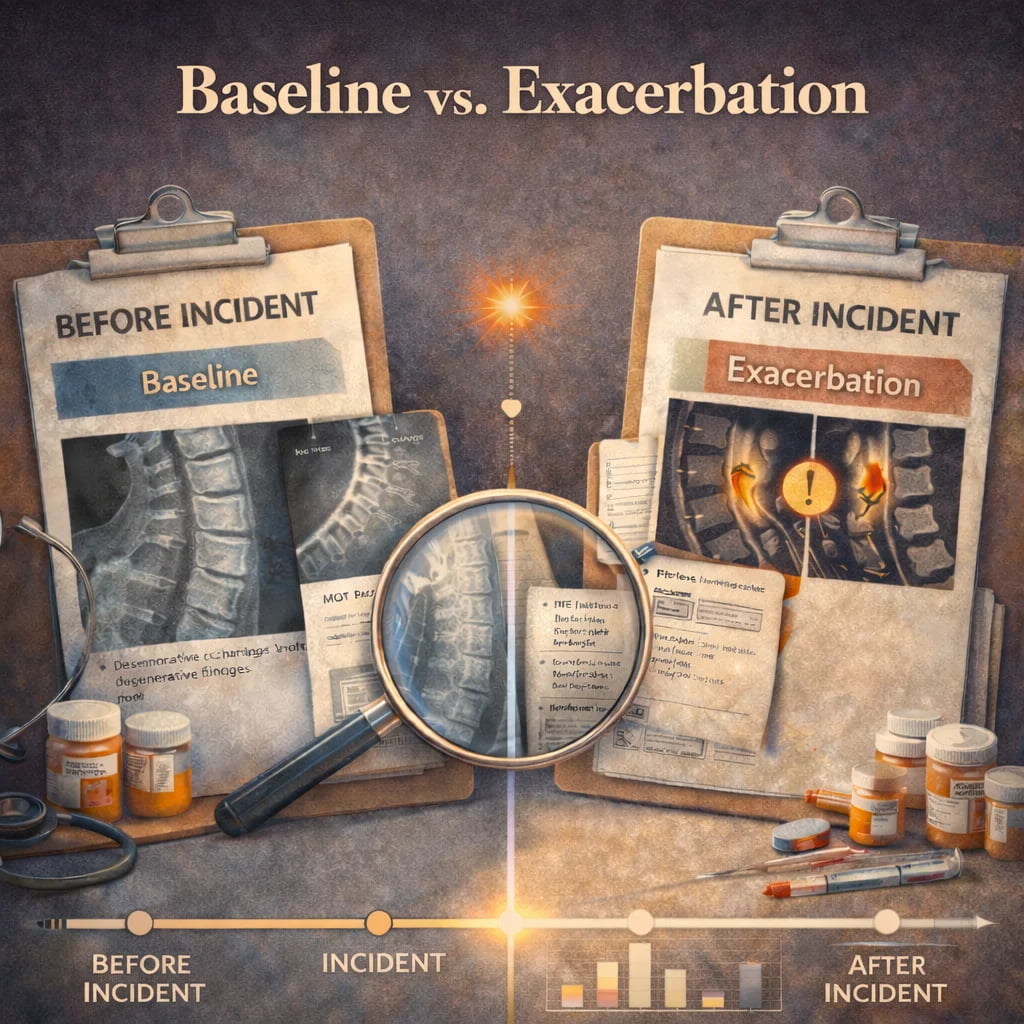
Start with a simple frame: baseline, change, and progression
A helpful way to organize the analysis is in three parts:
- Baseline: what the condition looked like before the incident.
- Change: what shifted afterward, and when it first appeared.
- Progression: how treatment, diagnostics, and function evolved over time.
When medical records are organized this way, attorneys can evaluate cases more confidently.
1) Build a baseline that is clear and fair
A baseline is not just a prior diagnosis. It is the best available picture of how the person was doing before the incident.
Medical record clues that help define baseline
- Prior visit notes showing symptom frequency and location.
- Prior imaging impressions showing long-standing findings.
- Medication history showing ongoing management or stability.
- Work status notes or functional documentation.
- Gaps in treatment that show stability over time.
A baseline can be stable even when a pre-existing condition exists. That is why the timeline matters more than the label.
2) Pinpoint the first documented change after the incident
The strongest arguments often start with timing. The question is not just whether a condition existed, but what changed and when it was first documented.
What change can look like in the record
- New symptom location, such as radiating pain.
- New severity or frequency documented consistently.
- New functional impact such as missed work, restricted activity, or reduced range of motion.
- New clinical findings on exam.
- New referrals or treatment recommendations.
A clear medical chronology makes it easy to spot the first documentation of change, which often becomes a key anchor point in case strategy.
3) Compare diagnostics with a focus on what is different
Imaging and testing play a major role in distinguishing baseline from exacerbation. The most helpful comparisons are direct and time-based.
Good diagnostic comparison questions
- Was there imaging of the same body region before the incident?
- If yes, do impressions show progression, stability, or new findings?
- If no prior imaging exists, does the clinical timeline still show a clear change in symptoms and function?
- Do later imaging results match the reported progression?
Even when imaging shows degenerative findings, the record may still support exacerbation through changes in symptoms, function, and treatment path.
4) Track treatment escalation, because it often tells the story
Treatment patterns are a practical way to show baseline versus exacerbation. A stable condition often has stable management. An exacerbation often looks like a step-up in care.
Common treatment escalation signals
- Increased visit frequency.
- New specialist referrals.
- Added therapies or expanded goals.
- New medications or increased dosing.
- Procedures such as injections.
- Surgical consultations or intervention.
- Expanded work restrictions or prolonged restrictions.
When escalation follows documented change, the story reads as a connected progression.
5) Use function as the daily-life bridge
Medical records often mention function in small pieces. These details help distinguish an existing condition from an incident-related exacerbation.
Functional details that matter
- Documented limits that begin after the incident.
- Changes in the ability to sit, stand, lift, or perform tasks.
- Therapy notes showing improvement or persistent limitation.
- Use of assistive devices or modified activities.
- Restrictions that were not present before or that expanded after.
Function helps reviewers understand impact in a concrete way, which supports a clearer evaluation of damages.
6) Keep the causation narrative grounded in the record
A defensible causation argument is built from the record itself. A strong medical summary separates baseline history from post-incident progression, uses dates consistently, highlights the first documented change, and shows how diagnostics and treatment follow that change.
When this is done well, the medical story becomes easy to explain in mediation, easy to discuss with experts, and easy to support in trial preparation.
A practical checklist: baseline vs exacerbation
When reviewing records, these questions help clarify the picture:
- What was the last documented status before the incident?
- Is there a documented period of stability with limited care?
- What is the first post-incident complaint, and is it consistent?
- Are there new findings, new symptoms, or new functional impact?
- Do diagnostics align with the clinical progression?
- Does treatment escalate in a way that matches the timeline?
How Medilenz supports defensible analysis
These cases are easier to evaluate when the timeline is clean and key medical points are organized for litigation needs. Medilenz drafts litigation-ready medical chronologies and focused medical summaries that make baseline and post-incident changes easier to identify.

Medilenz supports teams by:
- Organizing records into a clear, chronological timeline.
- Highlighting first documented symptoms and meaningful changes.
- Structuring diagnostics and treatment escalation for review.
- Providing outputs that are easy to reference for medical and case management teams.
For cases involving pre-existing conditions, a clear record supports accurate decision-making from intake through trial preparation.
Closing thought
Pre-existing conditions do not decide case outcomes; the medical record story does. When the file shows baseline, change, and progression through timelines, diagnostic comparisons, and treatment escalation, the argument around exacerbation becomes easier to defend.