The Difference Between a Narrative Summary That Holds Up and One That Doesn't
Two narrative summaries can be built from the same medical records and still lead to very different outcomes once a case gets tested. One narrative summary holds up under scrutiny from defense counsel. The other gets picked apart in the first round of discovery, and the attorney ends up defending the document instead of the case.
The gap between the two narrative summaries rarely comes down to how the high volume of medical records was handled. It comes down to how the narrative summary was constructed, and whether the person drafting it understood where the line sits between what the records actually say and what they seem to suggest.

What “Holds Up” Actually Means
A narrative summary that holds up in litigation does a few things consistently. Every claim in it traces back to a specific entry in the source medical records. Causation is explained, not just implied. The terminology stays consistent from the first page to the last, so a reader is not left guessing whether two different phrases describe the same finding. And there is a clear line between what the medical record documents and what the summarizer is interpreting from it.
None of that sounds complicated on paper, but in practice, it is where most of the problems start. A rushed summary might state that a patient's condition “worsened after the accident” without pointing to the specific visit where that was documented. A defense attorney does not need to disprove the claim. They only need to ask where it came from, and if there is no clean answer, the credibility of the whole document takes a hit.
Side-by-Side: What Separates the Two
| Feature | Narrative Summary That Holds Up | Narrative Summary That Doesn't |
|---|---|---|
| Source traceability | Every claim links back to a specific record entry | Claims are stated without clear sourcing |
| Causation language | Explained with supporting clinical reasoning | Implied or asserted without connecting evidence |
| Terminology | Consistent throughout the document | Shifts between terms for the same finding |
| Tone | Objective, fact-based | Interpretive language that reads as opinion |
| Pre-existing conditions | Acknowledged and distinguished from new findings | Ignored or glossed over |
| Gaps in treatment | Noted, with context where available | Left unaddressed, creating an opening for the defense |
Where Weak Narrative Summaries Break Down in Practice
Personal injury case: A rear-end collision case with a disputed pre-existing back condition needs a narrative summary that draws a clean line between what was documented before the accident and what changed after. A summary that skips this step, or addresses it in a single vague sentence, hands the defense an easy opening to argue the injury was not caused by the accident at all.

Medical malpractice case: In a case involving a delayed diagnosis, the narrative has to connect the dots between when a finding appeared in the record and when a provider acted on it. If the summary states that the diagnosis was “delayed” without identifying the specific lab result or imaging report against which the delay is measured, the claim reads as an accusation rather than a documented fact. That distinction matters in how the summary holds up under review.
Workers' compensation case: These cases often involve records from several different providers, and terminology around functional limitations can vary from one specialist to another. A narrative summary that does not reconcile that language, or that uses one provider's phrasing as if it were consistent across the whole file, creates confusion that carriers contesting the claim are quick to exploit.
Mass tort case: With dozens or hundreds of plaintiffs, the temptation is to standardize the narrative structure and move fast. But if a template gets applied without adjusting for what is actually different about each claimant's file, the summary starts to read like it was written about a category of people rather than an individual patient, and that undermines the specificity the claim depends on.
In each of these situations, the underlying medical records were not necessarily the problem; it is the gap opened during how the narrative was written.
Why AI + Physician Review is What Closes the Gap
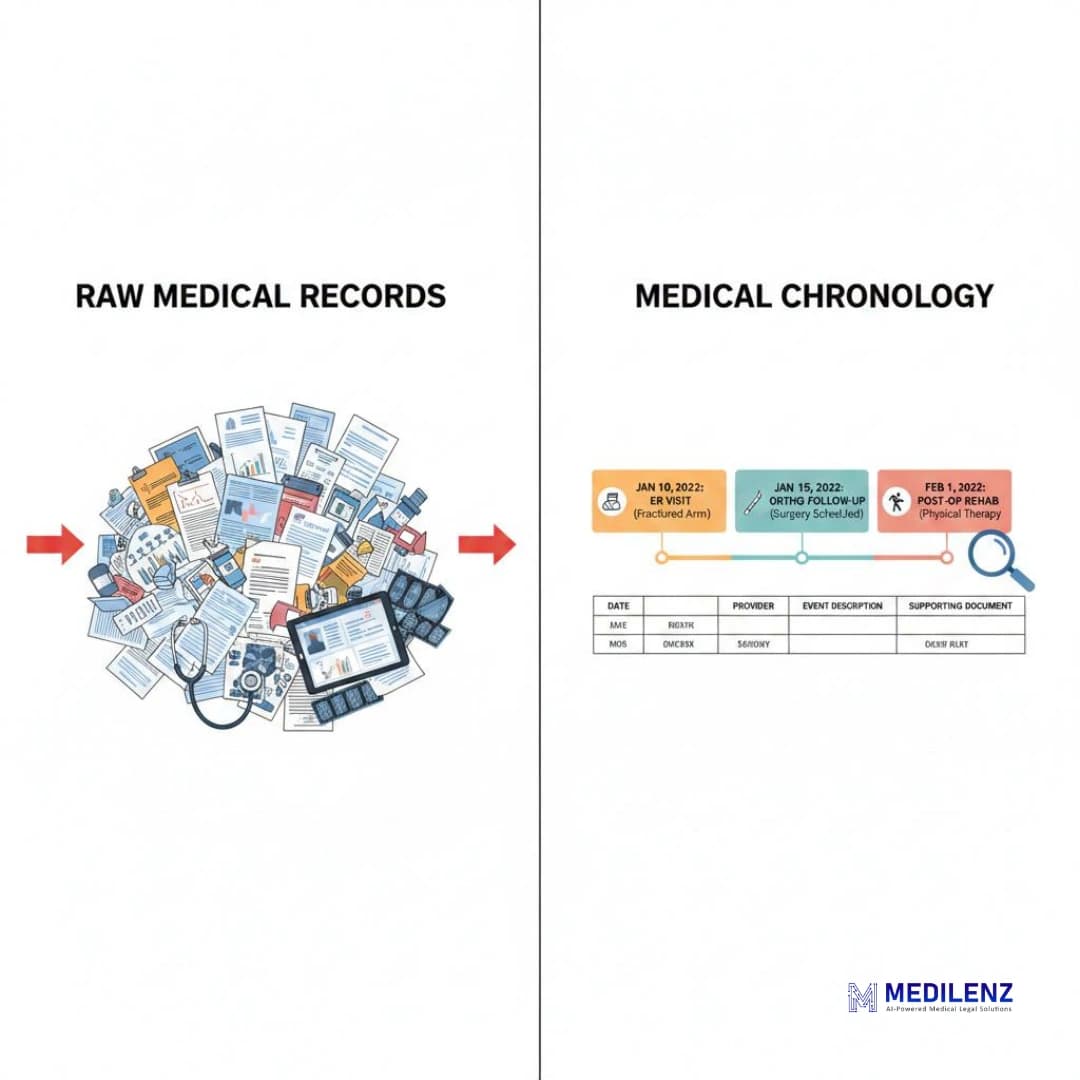
AI can sift through a large volume of records quickly, pull out relevant events, and organize them in chronological order. This part of the process is genuinely useful, especially in cases with years of treatment history or when multiple providers are involved.
What AI cannot do reliably is to judge where a clinical claim is fully supported and where it is a reasonable but unproven inference. That judgment call is exactly where physician review earns its place in the process. A reviewing physician reads the narrative the way a defense expert eventually will, looking for the sentence that overreaches, the causation statement that needs one more supporting citation, or the phrase that blurs fact and interpretation. Catching that before the narrative summary reaches the attorney is the difference between a document that supports the case and one that becomes a liability during depositions or cross-examination.
This is also where consistency across a firm's cases matters. When every narrative summary goes through the same standard of physician review, attorneys don't have to worry if a particular deliverable is stronger or weaker than the last one.
The Bottom Line
A narrative summary is not judged by how well it reads in the first instance. It is judged by how well it holds up the third or fourth time someone with an incentive to find a gap in it goes looking for one. Traceable sourcing, clear causation language, and a physician's eye for where interpretation has crept past what the record supports are what make that difference. The narrative summaries that survive scrutiny are not necessarily longer or more detailed. They are simply built with that scrutiny in mind from the first draft.