Evaluating a Medical Record Review Services Provider: A Buyer's Guide for Law Firms
Nearly every litigation case involving physical harm hinges on the timely, accurate review and processing of medical records.
How efficiently and thoroughly your firm reviews these records has a direct effect on case evaluation time, the accuracy of damages assessments during settlement negotiations, and ultimately the outcomes of mediations and trials.

Many vendors offer medical record review services today, and the quality, methods, and value they provide can vary significantly.
This guide identifies what to look for in a vendor, what questions to ask, and how to evaluate a vendor before assigning your cases to them.
What Medical Record Review Services Actually Provide
Medical record review services let attorneys and other legal professionals outsource the processing of voluminous raw clinical information into usable litigation materials.
These usable materials include:
- Medical chronologies
- Narrative summaries
- Demand letters
- Future medical cost projections
- Life care plans
- Expert medical opinions
- Plaintiff factsheets
- And more.
Depending on the requirements of a specific case, medical record review services may produce one type of material or several.
Regardless of which material is produced, the end result is the same: large volumes of unorganized medical documentation transformed into well-organized litigation materials.
Beyond producing organized litigation materials, a third-party medical record review service offers a secondary benefit: an objective reviewer who helps identify the information that matters most within the records.
For example:
- A two-year history of medical treatment records compiled from six different healthcare providers can be transformed into a chronological list of the events surrounding a client's injuries.
- An extremely complicated medical malpractice case can be converted into a detailed written summary prepared by a physician that helps prepare an expert witness for his/her testimony.
- A worker's compensation claim where causation is disputed can be supported by a documented review that outlines when a client's injury began and relates that injury onset date back to the client's employment activities.
- A mass tort docket with thousands of plaintiff files can have identical chronologies created for each plaintiff.
Ultimately, the vendor you select determines how every medical document flows through your litigation process.
Important Evaluation Criteria Prior To Selecting a Provider
Prior to selecting a provider, consider the following criteria.
1. Physician Involvement
Physician involvement in producing medically related documents is the single most critical factor in determining document quality.
A chronology or narrative summary produced without physician input is merely an organizing tool.
When physician input is part of the process, however, the resulting document becomes clinically credible — capable of supporting expert testimony, withstanding questioning at deposition, and holding up at trial.
Ask every provider you contact:
- Who reviews the final version of the documents produced by your company?
- What are the qualifications of this person?
- Is there physician involvement in reviewing each file or is there physician involvement limited to certain types of cases?
Physician involvement is non-negotiable in medical malpractice cases.
It's similarly essential in complex personal injury cases involving permanent injuries or disputed causation.
Physician involvement is less often necessary in workers' compensation claims and mass tort cases, though including physicians in damages-related file reviews still adds objectivity and credibility to the assessment.
2. Use Of Artificial Intelligence (AI) and the Limitations Of AI
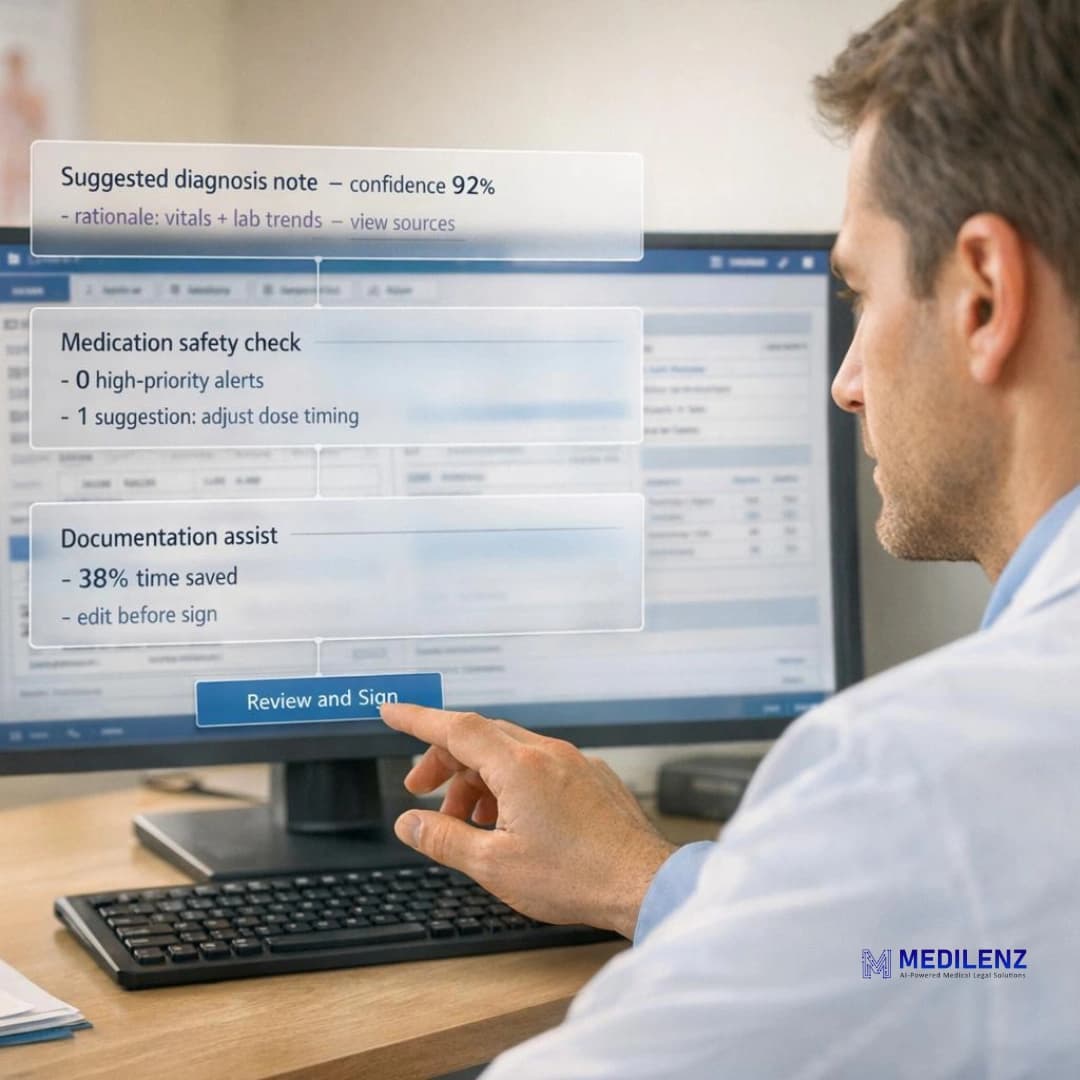
Artificial intelligence (AI) technology has dramatically increased both the speed and scalability of medical record review.
Providers using AI can process very large volumes of records far faster than traditional manual methods, while producing a consistent organizational format across records.
AI also reduces the risk of errors caused by oversight when processing high-page-count files.
Even so, AI still lacks the capability to make clinical judgments about the patient data contained in medical records.
It cannot interpret subtle nuances in clinical findings, nor evaluate whether the treatment a patient received met the applicable standard of care.
For purposes of preparing documents intended to be used in a legal proceeding, AI technology must serve only as a processing layer in front of a physician reviewer.
Best practice is for providers to pair AI's rapid processing capability with physicians for clinical relevance.
Ask each provider you speak with how they currently integrate AI technology with their physician reviewers.
3. Documents Offered
Each stage of a case requires specific documents.
An attorney limited to chronological records alone can't give a client a narrative of case events, projected medical costs, or documentation of the services a life care plan would require.
Attorneys handling personal injury, medical malpractice, workers' compensation, and mass tort cases are best served by a provider capable of producing every necessary litigation document at every phase of the case.
4. Quality Control and Accuracy
Ask every provider how they identify errors before delivering documents to attorneys.
- Are there multiple steps taken to check for errors prior to delivery?
- Are physicians reviewing and signing off on the complexities of files delivered?
- What happens if an error is discovered post-delivery?
A provider with a clearly defined error-checking process has built accuracy directly into its workflow.
A Direct Comparison of Human Review vs. AI-Only Review vs. AI + Physician Review
| Factors | Human Review (Physician) | Human Review (Non-MD) | AI Only Review | AI + Physician Review |
|---|---|---|---|---|
| Speed | Quick | Quick with a Layer of Accuracy | Very Fast | Fast, AI-Accelerated |
| Volume Handling | Large Volumes | Large Volumes | Very Large Volumes | Very Large Volumes |
| Physician Interpretation | Full Physician Interpretation | Limited Physician Interpretation | No Physician Interpretation | Full Physician Interpretation, AI-Assisted |
| Consistency & Error Detection | High, Manual Cross-Checking | Moderate, Manual Cross-Checking | High Pattern Detection, No Physician Validation | High Pattern Detection, Physician-Validated |
| Scalability | Limited by Physician Availability | Limited by Staff Capacity | Highly Scalable | Highly Scalable, Physician-Verified |
| Deposition Defensibility | Very High | Moderate | Low | Very High |
| Standard of Care Analysis | Yes | No | No | Yes |
| Best Use Cases | Most Complex Case Types — Malpractice / Catastrophic Injury / Complex PI | General Organizational Tasks — Intake Screening Early in a Case | Initial Data Extraction and Organization Only — Not Recommended for Complex or High-Stakes Cases | All Litigation Documents — Malpractice / Catastrophic Injury / Complex PI, High-Volume Mass Tort |
How Medical Record Review Services Help Attorneys Reduce Overhead

Pricing across the industry typically runs on a per-hour model. Some providers offer per-page pricing, though that's generally the AI-only review companies. Flat-project fees are less common and tend not to work as well in practice. Since the right pricing structure depends on your firm's own case mix and volume, that's a conversation to have directly with a provider rather than a one-size-fits-all answer.
The bigger cost consideration is what outsourcing frees up inside your firm. Every hour a paralegal or attorney spends sorting, organizing, and summarizing raw medical records is an hour not spent on case strategy, negotiation, or client communication — the work that actually moves a case toward a favorable outcome.
Handing off chronology and summary work to a dedicated review service lets your team focus on what they do best: building the case and securing the compensation your clients deserve, rather than working through boxes of medical records.
A lower per-page rate from an AI-only provider may look appealing at first glance, but skipping physician review can mean added time spent reworking a document that doesn't hold up in court, or a missed clinically significant finding that would have increased the value of the case. The real question is which provider frees up your team's time while still delivering a complete, litigation-ready document.